Back in May, I wrote about the official uniform of Paraguay. To refresh your memory--or if you didn't read that post--it basically consists of a Paraguayan national soccer team jersey, baggy shorts, toe wedge sandals, and a guampa (basically, a large water bottle used to refill cups of tea).
Recently I figured out the official slogan of Paraguay: "Come back tomorrow. It'll be ready then." It seems as if no matter what you need or want, be it a signature on a document, artwork, laundry, an answer to a question, or anything else you simply cannot get it on the day that you were originally promised. In other words, if you are told to return on Tuesday to get whatever it is that you need and then you do return on Tuesday, you will be met with the seven words mentioned above. And just because you are told that "it" will be ready tomorrow doesn't mean that it is so, which brings me to the translation of Paraguay's official slogan.
"Come back tomorrow. It'll be ready then." really means "It's not ready and who knows when it will be so come back at a later, undetermined time and hopefully it will be ready then." This could mean the following day or, more likely, the following weeks sometime. In Paraguay, it's all a guessing game.
Friday, November 13, 2009


Thursday, October 22, 2009
Visa Paradise
Will wonders never cease? It's finally for real officially official. This past Tuesday, October 20, 2009 at approximately 11:45 am, Catherine and I received our temporary resident visas. When the woman handed me our two visas it was a wonderful, almost surreal moment since I had been to immigration at least a half a dozen times and walked away empty handed. But not on this fateful day. On this day the planets and stars aligned just right, the gods smiled down on us, the sun shone brightly, the clouds parted, and I walked out of the immigration office for the last time.
Now we can legally stay in Paraguay until October, 2010. It feels good to be on the up and up and finally have our visas in hand even though we return to the states in a mere eight weeks. We did, however, come close to our prediction that our visas would be handed to us as we were boarding the plane. Hey, what's a nine month delay when it comes to government paperwork?

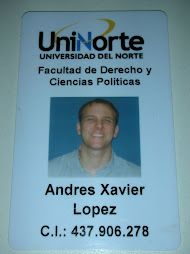
My visa.

Catherine's Visa.
Now we can legally stay in Paraguay until October, 2010. It feels good to be on the up and up and finally have our visas in hand even though we return to the states in a mere eight weeks. We did, however, come close to our prediction that our visas would be handed to us as we were boarding the plane. Hey, what's a nine month delay when it comes to government paperwork?

My visa.

Catherine's Visa.
Tuesday, October 20, 2009
It's cliché I know, but: Fame! I'm Gonna Live Forever.
Since Grease I have been working on Fame at the Stael Ruffinelli de Ortiz English Language School. This time instead of merely being the assistant director and pseudo language coach, I will play the part of Mr. Myers, the acting teacher. But enough about me. Back to the students.
Even though the students in both shows are approximately the same age, they differ greatly in attitude, work ethic, and discipline. The Fame students come to rehearsal on time and prepared to work. It is such a welcome change from having to wait for 45 minutes to over an hour for the Grease students to arrive. And rehearsals are focused, solid, and productive. What a difference.
Do not get me wrong, Grease was a great show. The students did an excellent job and they really came together in the end. By the final performance they were comfortable with their characters, the audience, and each other. Yes, it was the last performance; however, there is an old addage in the theatre that I'll paraphrase here. It says that every show has a ton of dress rehearsals and closing night. This is exactly what happened with the cast of Grease.
Fame goes up in just over four weeks and I believe it will be a spectacular show. Everyone has been working incredibly hard singing, dancing, acting, memorizing lines, speaking in a foreign language and putting in more hours in rehearsal than most people put in at part-time jobs. Having said that, there is still a lot of work to be done before those curtains rise and "I'm gonna live forever" sounds throughout the theatre.
Now, maybe to balance out the superstitions of the theatre, I should say that the show will be a disaster. But where's the fun in that? Granted, I have been put into an extensive dance number where I will be jumping and spinning, picking up other dancers and putting them on my shouldes, twirling and galavanting all around the stage, but I still don't forsee a disaster. Wishful thinking? Not with two years of ballet and a Movement for Actors class in grad school that was really a cover for Intense Modern Dance 101.

Giving some instructions to the actors.

Working on lines and blocking with "Serena."
Even though the students in both shows are approximately the same age, they differ greatly in attitude, work ethic, and discipline. The Fame students come to rehearsal on time and prepared to work. It is such a welcome change from having to wait for 45 minutes to over an hour for the Grease students to arrive. And rehearsals are focused, solid, and productive. What a difference.
Do not get me wrong, Grease was a great show. The students did an excellent job and they really came together in the end. By the final performance they were comfortable with their characters, the audience, and each other. Yes, it was the last performance; however, there is an old addage in the theatre that I'll paraphrase here. It says that every show has a ton of dress rehearsals and closing night. This is exactly what happened with the cast of Grease.
Fame goes up in just over four weeks and I believe it will be a spectacular show. Everyone has been working incredibly hard singing, dancing, acting, memorizing lines, speaking in a foreign language and putting in more hours in rehearsal than most people put in at part-time jobs. Having said that, there is still a lot of work to be done before those curtains rise and "I'm gonna live forever" sounds throughout the theatre.
Now, maybe to balance out the superstitions of the theatre, I should say that the show will be a disaster. But where's the fun in that? Granted, I have been put into an extensive dance number where I will be jumping and spinning, picking up other dancers and putting them on my shouldes, twirling and galavanting all around the stage, but I still don't forsee a disaster. Wishful thinking? Not with two years of ballet and a Movement for Actors class in grad school that was really a cover for Intense Modern Dance 101.

Giving some instructions to the actors.

Working on lines and blocking with "Serena."
Echar This!
Is it me or does Spanish need more words?
to throw; to toss; (water, wine) to pour (out); (culinary) to put in, add; (teeth) to cut; (discourse) to give; (employment: despedir) to fire, sack; (leaves) to sprout; (letters) to post; (smoke) to emit, give out; (reprimand) to deal out; (story) to make up; to put on; ~ a correr/llorar to break into a run/burst into tears; ~ a reír to burst out laughing; ~se to lie down; ~ abajo (government) to overthrow; (building) to demolish; ~ la culpa a to lay the blame on; ~ de menos to miss; ~se atrás to throw oneself back(wards); to go back on what one has said; ~se una siestecita to have a nap
Yes, I know there are a lot of words in English that can mean a lot of different things too (just think of everyone's two favorite four-letter words). But the last time I checked, English had the most words of any language, somewhere between 750,000 and 1,000,000 words.
Echar: A Partial List
to throw; to toss; (water, wine) to pour (out); (culinary) to put in, add; (teeth) to cut; (discourse) to give; (employment: despedir) to fire, sack; (leaves) to sprout; (letters) to post; (smoke) to emit, give out; (reprimand) to deal out; (story) to make up; to put on; ~ a correr/llorar to break into a run/burst into tears; ~ a reír to burst out laughing; ~se to lie down; ~ abajo (government) to overthrow; (building) to demolish; ~ la culpa a to lay the blame on; ~ de menos to miss; ~se atrás to throw oneself back(wards); to go back on what one has said; ~se una siestecita to have a nap
Yes, I know there are a lot of words in English that can mean a lot of different things too (just think of everyone's two favorite four-letter words). But the last time I checked, English had the most words of any language, somewhere between 750,000 and 1,000,000 words.
Paraguayan Left Turn
Some intersections are quite busy in Asunción. They are so busy, in fact, that left turns become an exercise in right turns--three right turns, in fact. Instead of making a simple left turn onto the desired street, you must pass the street, turn right on the next available street, a right next on the following street, and finally another right onto the street you originally wanted to turn left on. Once you are finally on the street you wanted, you get to once again pass the intersection that you visited only moments ago. Fun! With rush-hour traffic a never ending stream of lights, horns, pedestrians, colectivos (buses), motorcycles, street vendors, and exhaust, what's one quick circle around the block? Unless that block turns into 12 and adds 30 minutes onto an already exhausting commute.
For those Michiganders who read this, you will probably notice that a Paraguayan left bears a slight resemblance to a 'Michigan left.' For those of you who happened to miss those wonderful creations of traffic engineering the last time you visited the only two peninsula state in the union, Michigan lefts are those wacky left turns that require a right turn followed by a U-turn, usually with a traffic light thrown in between. Here goes: Instead of turning left to continue your journey you must turn right and then immediately get into the far left lane so as to be prepared for the next step. Merging into the far lane after turning right is sometimes easy and sometimes virtually impossible, depending on traffic, the number of lanes you must successfully navigate, and how far down the U-turn is. Once you are in the far lane you drive to the designated U-turn spot and either wait for a) the traffic light to turn green, b) oncoming traffic to dissipate, or c) both before completing the U-turn. Once option a, b, or c presents itself you may then turn onto the street you couldn't originally turn left on. What could be easier? Oh, I know. Turning left.

A street sign indicating that to turn left onto Avda. Perú, you must make a Paraguayan left (i.e. pass Peru and make three rights only to emerge back onto Avda. Perú)
For those Michiganders who read this, you will probably notice that a Paraguayan left bears a slight resemblance to a 'Michigan left.' For those of you who happened to miss those wonderful creations of traffic engineering the last time you visited the only two peninsula state in the union, Michigan lefts are those wacky left turns that require a right turn followed by a U-turn, usually with a traffic light thrown in between. Here goes: Instead of turning left to continue your journey you must turn right and then immediately get into the far left lane so as to be prepared for the next step. Merging into the far lane after turning right is sometimes easy and sometimes virtually impossible, depending on traffic, the number of lanes you must successfully navigate, and how far down the U-turn is. Once you are in the far lane you drive to the designated U-turn spot and either wait for a) the traffic light to turn green, b) oncoming traffic to dissipate, or c) both before completing the U-turn. Once option a, b, or c presents itself you may then turn onto the street you couldn't originally turn left on. What could be easier? Oh, I know. Turning left.

A street sign indicating that to turn left onto Avda. Perú, you must make a Paraguayan left (i.e. pass Peru and make three rights only to emerge back onto Avda. Perú)
Sunday, September 27, 2009
Look Both Ways Before Crossing The Street
Mom's age-old advice about making sure no cars are coming before you cross the street rings especially true in Asunción. This is a city where the car--not the pedestrian--has the right of way. Be it a major, four-lane road or a single lane one-way street, it is wise to check both directions before taking that fateful first step off the sidewalk and into the street. Sometimes you even need to check the sidewalk for that random motorcycle who feels like using your designated walkway as a personal lane to skip the traffic. More on this later.
The major roads are pretty easy. Everyone knows to look both ways and proceed with caution. Most people will wait for an intersection before daring to leave the safety of the sidewalk; however, since there is no jay walking law here you may occasionally find that brave soul who throws caution to the wind and crosses in the middle of the street. My wife and I have been known to do this as well, especially on a hot day and the other side of the street beckons us with its shade. Keep in mind that when you do cross, be it at an intersection or the middle of the street, to keep an eye out for two things: motorcycles moving up between the lanes and that overzealous driver who speeds past everyone in the oncoming traffic's lane to make the green light.
Somewhat trickier are the smaller roads (two lanes or fewer) since they might be two-ways or one-ways. The signs marking these streets' directions are generally small and difficult to find, if they exist at all. This makes knowing which way to look especially tricky. Furthermore, since these smaller roads tend to be found mostly in residential areas (downtown being the big exception), people frequently cross them whenever and wherever they please. The best way to know which direction the traffic flows on these streets is to memorize it. You could look at which way the parked cars face, but that can be misleading since cars will park whichever way suits their fancy at the time. (Those of you who live in Texas know what I'm taking about.) Another seemingly smart thing to do is see which way the cars are heading and deducing from there where to look before crossing. But again, I urge you to exercise caution when doing this. Cars are known to ignore the signs--and sometimes other cars traveling in the opposite direction--to go down a one-way street so they do not have to travel around the block. It can be quite surprising to see a car whiz past you going in the wrong direction down a street that you know is a one-way.
As you may have noticed, motorcycles have no problem driving between lanes to get farther ahead. They also have one other trick they employ when they just don't want to use the streets. They drive on the sidewalk. That's right, if traffic is bad or the road just doesn't hold that magical appeal anymore the motorcyclist will opt for the sidewalk. And you better watch out. It doesn't matter if you were there first or even the trivial fact that sidewalks are made for walking, if Mr. Motorcycle wants to drive down it you are the one who's moving. To avoid this, maybe you should cross the street...
Looking both ways before crossing the street is not only sage advice passed on from mother to child; in Asunción it's a survival technique.
Friday, September 18, 2009
Paraguay's Two Seasons: HOT and Not Quite As Hot
As today's high hit 94 wonderful degrees, I realized that Spring has officially hit Paraguay. Even though the new season doesn't officially start until next Tuesday (Sept. 22), the oppressing heat has returned to remind everyone that even more oppressive summer heat is just around the corner. And in that brief description are Paraguay's two seasons: HOT and Not Quite As Hot.
The summer months--December, January, and February--are unbearably hot. Temperatures average at least mid 90s during the day (with most days above 100) and, at the lowest, mid 80s at night. Humidity never breaks, not even for a day and not even when it rains. When it does rain, outside feels like a steam bath. March and April offer no respite from the heat. Days might dip into the low 90s but the nights are still just as hot. May is the first month where the glimmer of cooler weather starts to emerge. But by 'cooler weather' I mean temps in the 80s. I guess cool is a relative term. Winter, described below, ushers in Paraguay's second season. Once those all too short three months are over, it's back to the season of HOT. Thanks, September, for reminding us that Paraguay hasn't forgotten how to turn the streets of Asunción into an oven.
I must admit that Cat and I enjoyed a nice three month reprieve: June, July, and August. Aside from a few cold nights where the mercury registered the low 40s, the temperature still averaged in the 70s during the day and 50s at night. Coming from constant triple digit highs and lows in the mid 80s, highs in the 70s were incredible. And we felt nice and cool.
Unfortunately, Cat and I won't see those nice, cool temps until December when we return to the States and Northern Hemisphere winter. Texas will be going through its own version of Not Quite As Hot and Cat and I will take full advantage of it. Plus, we'll have air conditioning everywhere we go, be it in a house, a car, a store, a restaurant, everywhere! Oh, the possibilities are endless.
Saturday, September 12, 2009
Spanish Speaking Milestone
While on vacation a few weeks ago in Chile, my parents, Cat and I returned to Santiago from Viña del Mar via a bus. When we arrived at the bus station a taxi driver greeted us at the bus and offered to take us to our hotel. Cab drivers normally approach bus passengers and offer to drive them to their hotels, apartments, etc. so this was nothing abnormal. We decided to go with this particular driver for whatever reason and piled into his car.
The driver suggested that we take the freeway to our hotel because it would be faster and easier than taking surface streets. Based on what little I knew about the city (having been there only once before) it sounded reasonable and not like he was trying to take advantage of us out-of-towners.
As promised, the ride was fast and easy. I sat in the front and enjoyed a nice conversation with the driver. When we arrived at the hotel everyone else unloaded the luggage from the trunk while I paid the driver the fare plus a small tip. However, this did not seem to satisfy him. He pulled out a 1000 peso bill and gestured vigorously at me with it.
The following took place entirely in Spanish.
The cab driver told me that I still owed him 1000 pesos. Wanting to make sure I understood him correctly, I asked him to repeat what he just said? He said again that I owed him 1000 pesos. Surprised, I asked why I owed the extra money? He told me that the freeways were in fact toll roads and that I owed him for those tolls. I asked why he did not tell me this beforehand so I could decide whether to take said toll roads (and incur the extra charges) or stick to the surface streets. Instead of answering my question he pointed to the bill and told me that I owed him more money. Refusing to yield, I kept asking him why he didn't tell me about the extra charge. To which he again pointed to the 1000 peso bill and told me that I owed him more money. Finally, after he realized that I wouldn't pay until he answered my question, he relented. He told me that he didn't tell me about the extra charge because he thought I knew about it. Laughing out of disbelief, I asked him how I could possibly know about it when I am from the United States. Oddly enough the driver could offer no explanation. By this time my dad came over and asked me what was going on. I explained everything and my dad said to just walk away and not pay. Taking his advice, I told the driver that I was not going to pay. I shut the passenger door and started walking toward the hotel entrance. The driver got out of the car and yelled something inaudible. Obviously my dad understood what he said because he told him that he had his number and was going to report him. Upon hearing this, the driver immediately got back into his car and drove off.
My parents, Cat, and I surmised that we probably did owe the driver the extra toll charge, but we were upset that he never told us. Instead, he assumed we already knew (or at least that is what he said). We also found it difficult to believe that the extra charge was 1000 pesos. Based on that number (about $2 for every 4-5 miles), freeway/tollway driving in Chile is one very expensive undertaking. And I thought the new tollways in and around Austin were pricey.
Now the point of this blog is not to complain about possibly crooked Santiago cabbies or the cost of driving in Chile. Rather, it is to mention a milestone. I argued completely in Spanish with a cab driver and we both knew exactly what the other person was saying. In other words, I understood his Spanish and he understood mine. Despite the unpleasant ending to the ride, I was very happy that I could even have the argument. If only all my conversations in Spanish were as clear.
Wednesday, September 9, 2009
San Bernardino: The Hamptons of Paraguay

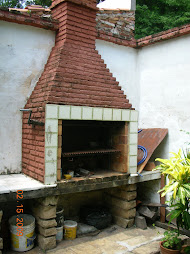
Most middle to upper middle class Paraguayan families that live in Asunción have a summer home in San Bernardino, a small, lakeside town a relatively short 40 minute drive from the city. The town is tiny and hardly anyone lives there year round. Instead, San Bernardino serves as a summer getaway. When the heat and humidity becomes unbearable in January and February, families pack their bags, temporarily close their Asunción homes, pile in the car, and escape to their summer homes in San Bernardino. After two months of lounging around on the beach, sipping drinks poolside, late night parties, and relaxing the summer away, families pack their bags, temporarily close their San Bernardino homes, pile in the car, and return to the city for another 10 months of work or school.
A few Sundays ago Cat and I visited this vacation town. We were invited to spend the day there with one of my students, Mati, and her family. Naturally, an asado (Paraguayan barbeque) was the meal of choice. And, true to Paraguayan form, the family was incredibly welcoming, generous, and treated us as if we were long lost friends.

It started with Mati and her husband driving 25 minutes back into Asunción to pick us up after they had spent the entire morning at their youngest daughter’s golf tournament. On the way to San Bernardino, we stopped twice on the side of the road to buy strawberries and chipa just so we would have a snack while waiting for the asado. Once we arrived at the house the grandmother talked us up and down, asking questions, telling stories, sharing her ‘love’ for the military government that she grew up with, regaling us with her crazy protesting and subversive, anti-establishment days, explaining the joys of orgasms, and predicting when Cat and I were going to have children. She even predicted the exact day we would conceive (this September 21st). In other words, she was the crazy, old, loving, still young at heart grandmother that exists in all families. As she told us story after story, her husband just smiled and shook his head slightly. It was quiet acknowledgement that he’s heard it all before and, yes, his wife is crazy but he still loves her dearly.
After eating, Mati and her husband drove us all around town showing us the historic San Bernardino hotel (where Cat and I are supposed to conceive), the club on the lakefront, the downtown area, and the small ice cream stand where we stopped for a delicious strawberry smoothie-type creation. On the way back to Asunción we stopped at a mall to pick up yet more food. Cat and I mentioned that we never tried a quintessentially Paraguayan food, whose Guarani name escapes me at the moment. It was flat and thin, made of cheese and bread, and served hot. Despite being sufficiently full and not hungry at all from a day of non-stop eating, it was delicious. Of course Cat and I ate every last bite.

A day complete with wonderful company, tasty food, intriguing stories, and great memoires—what more could Cat and I ask for?
Sunday, August 16, 2009
Day Trip to San Bernardino
Below are a few pictures followed by my wife's perfect summary of our trip today to San Bernardino.
 portion of the patio of Mati's house
 front entrance of hotel del Lago
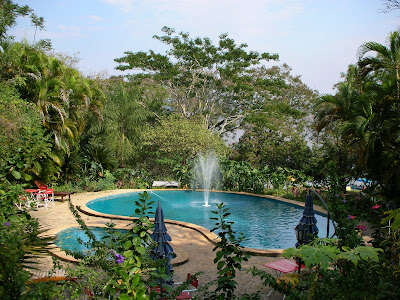 pool area of Hotel del Lago
 Cat in the dining area of Hotel del Lago
 upper balcony of Hotel del Lago
 portion of the patio of Mati's house
 front entrance of hotel del Lago
 pool area of Hotel del Lago
 Cat in the dining area of Hotel del Lago
  upper balcony of Hotel del Lago
Today we got invited by Andres' student and her husband to join them at their lake house in San Bernadino (40km outside of Asuncion). They had to take their daughter to an early golf tournament, which is about 25 minutes outside the city. Around 11:30 am they came back into the city to pick us up and then drove the 40 kilometers to the lake house. This is a perfect example of Paraguay's greatest asset, the people. They are generous to a fault and willing to extend their hospitality and make us feel welcome all the time. We were waited on hand and foot and yet never felt like an inconvenience. They made us a delicious lunch and had wine followed by a delicious trifle for desert. They even gave us a great tour of the town, stopping at scenic overlooks and beautiful hotels. There was one beautiful old hotel that looked like an old castle. Each room is named after a famous Paraguayan who stayed in that particular room. They even got someone to open one of the rooms so we could peak in. It was amazing. Mati's (Andres' student) Mom told us many stories while on our tour. She said that Andres and I need to come back here on Sept. 21st and pretend to me newlyweds and stay at this hotel. That will allow us to see it all through the romantic eyes of honeymooners and if we happen to get pregnant even better. She really wants Andres and me to have children and not to go to the hospital and instead have a natural birth at home with a midwife. If they only had the drugs.San Bernadino is an amazing town. It is picturesque, centered around a large beautiful lake. Apparently a lot of foreigners, especially Germans tend to settle there and I can see why. The buildings are older, but in great condition. There are bars with seating outside, a park and delicious ice cream parlors! Today was technically still winter, even though it was above 80 degrees by 9am. There was hardly anyone in town, because even though many people who live in Asuncion own homes there, they only go there for about a month in the summer. I don't really get that, but I enjoyed taking advantage of no traffic or lines and having the city basically to ourself. If I couldn't live there, I would definitely be out there on the weekends. The family's house that we went to today was a block from the lake and their mom, sister and cousins own homes right next door. All the family can be together, because in Paraguayan culture, family is #1. Each home has a large patio with a built in barbeque area, tiled counter space and outdoor sink. It was beautiful.As if that isn't enough, there is a country club that pretty much everyone belongs to within walking distance of their home. It has full lake access, 2 pools, a soccer field, several tennis courts, a gymnasium, large outdoor party area, man-made beach, restaurant and bar. There is a large dock area and a marina to store the boat and other water toys. If you are a member there, you also get to be a member at their large club in the middle of Asuncion. They drove us by there on the way home and it was equally as impressive, minus the lake access, of course. They also found out on the way home that we had never tried Mbeyu Queso. So they stopped on the way to our apartment and bought us some. Even though I was full from our day of eating, I still dove in and boy was it delicious. Mati also made a list of all the sites and places to visit while we are in Buenos Aires next week. She and her husband discussed it on the drive back and compiled a whole list of things for us. Because Mati and her family will be in Buenos Aires around the same time, we made tentative plans to all get together. The people here are amazing and this is just one example of what we have encountered.
Thursday, July 30, 2009
Happy Friendship Day
Today, July 30, is Friendship Day in Paraguay. It is just like Valentine's Day, except it occurs in July and it is more geared towards friends. Friendship Day is as important and as seriously celebrated as Valentine's Day is in the States; however, you do not need a significant other to feel special on this particular day. Anyone and everyone participates.
This is not to say that Valentine's Day is not celebrated in Paraguay. It is. However, it is solely for couples so those without someone special in their lives must sit on the sidelines and watch as couples partake in all the traditions and mores of February 14.
When two guy friends see each other, they say 'felicidades' (congratulations) and exchange a hearty handshake. When a guy and a girl or two girls see each other, they too say 'felicidades,' followed by a kiss on each cheek and a big hug. Close, and even not so close, friends then exchange gifts. They range from small toys to candy to stuffed animals to the traditional flowers and chocolate. Today is a day of togetherness and happiness, celebrated by all.
¡FELICIDADES!
School's Back in Session
This past Monday (July 27), after an extended winter break, school reopened for all students. Officials felt it was safe to allow everyone to return to their respective locales of learning, deeming the swine flu scare over. Despite the okay from the government that schools are once again safe, the schools seem to be about half full. Either people are still on vacation or they don't quiet agree with their elected officials.
It was a nice, quiet, pleasant three weeks. There were no constant screams and yells from recess or horns from parents' cars during after school pick up. Thankfully, because the students are not back in full force yet this week is acting like a buffered transition back into the near constant noise that fills up the day. Ah, kids...youth is wasted on the young!
Saturday, July 25, 2009
Swine Flu Closes Schools
The swine flu (a.k.a. H1N1) has made its way to South America. Actually, it arrived about a month ago but it didn't really make much of an impact until it all but shut down Buenos Aires (B.A.) three weeks ago. News reports showed vacant B.A. streets and shuttered up storefronts. It was as if the Argentine capital was deserted. Tourism virtually stopped and stores and restaurants closed.
The flu outbreak coincided with Asunción's schools' two week winter break. Vacation, as students and teachers lovingly call it, started on Monday, July 6 and was originally scheduled to end on Friday, July 17. However, because of fears that the flu could spread quickly among students--especially young ones--the government decided to extend winter break another week. This fear was not unfounded since the week before winter break several schools closed early after over half of their students got the flu. In one particularly bad case, one school reported a 90% sick rate among its students.
This coming Monday, July 27 is supposed to be the first day of school after the extended winter break; however, another problem has presented itself. Public school teachers have gone on strike, demanding more pay and better working conditions. This strike has threatened to extend the already extended winter break at least another week. Paraguay's education minister has been frantically trying to resolve the strike before Monday. Unfortunately, it doesn't look good.
What originally was supposed to be a two week breather in the middle of the school year has turned into a mini summer vacation of three or, more likely, four weeks. While I am sure that students welcome an extra two weeks of no school, the fallout of such a long-lasting break will surely affect the school year. Namely, what will happen at the end of the year? Will the school year still end on its regularly scheduled day? Will it be extended an extra week or two to make up for the lost time over break? And if the school year is extended, will the teachers get paid for that extra time? Additionally, an extended school year puts summer travel plans in jeopardy, especially for those who leave immediately after school lets out (which is surprisingly common). Everything is up in the air right now. It will be interesting to see what happens over the coming weeks and months. One thing I do know; the Minister of Education's job is not one I envy.
Tuesday, July 21, 2009
Potable Water
I cannot believe I have not mentioned this before. Contrary to popular belief, not all tap water south of the border comes packed with its own version of Montezuma's revenge. Granted, in a majority of countries it is still advisable to steer clear of tap water in any of its forms. Hence, why bottled water quickly becomes everyone's friend.
However, Paraguay (along with Argentina, Uruguay, and Chile) has its fair share of safe, drinkable tap water. It is considered safe to drink the tap water in Asunción (the capital) and Ciudad del Este (second largest city). Once you venture outside the cities, though, the water is no longer treated and thus becomes unsafe to drink.
I found out quite by accident that Asunción's drinking water is safe. After a few weeks, I noticed that my house mother filled up the water pitchers directly from the sink and put them in the fridge. She did not boil the water, put in iodine tablets, or otherwise filter the water in any way. Since I had already been drinking copious amounts of water without getting sick I reasoned that it must be safe. My Frodor's South America travel guide and various websites confirmed it.
Safe, drinkable tap water makes everything--from cooking to washing fruits and vegetables to enjoying a refreshing glass of water--easier. It's great not having to worry if the ice in a drink at a restaurant is safe or if lettuce was washed in dirty water.
Thursday, July 16, 2009
Paraguay Visa Requirements, Part I
Obtaining a tourist visa for Paraguay is relatively easy. First, decide whether a single or multiple entry visa is the right choice. Second, send to the Paraguayan Consulate your passport and visa application. Third, wait for your visa to come in the mail. It shouldn’t take longer than three or four weeks to arrive. Pretty simple. I think my visa arrived about two weeks after I sent in my application.
If you plan on staying for longer than 90 days—which is what a tourist visa allows— you will need a one-year temporary resident visa. A 10-year permanent resident visa is available too, but I am going to stick with the visa that I am still attempting to procure. As you will see, the necessary documentation for the longer term visa grows by leaps and bounds. (As always, contact the Paraguayan Embassy to get the latest immigration information.)
The following is from a form I received at the Paraguayan Immigration Office. Keep in mind that everything is in Spanish and no one speaks English. Also be prepared to spend a lot of time—months—collecting all of the necessary forms, signatures, and stamps. And once you submit your forms, be prepared to wait some more to finally receive your visa.
The first four requirements (and number 12) are to be obtained in the country of origin and the next seven are to be obtained in Paraguay.
Visa Requirements
- 1. Document of Identity: Passport or ID license.
- 2. Birth Certificate.*
- 3. Marriage Certificate, Certificate of Divorce, or other documentation to show civil status.*
- 4. Local police record (from 14 years of age) from your country of origin or from where you lived for the last five years. For people from Argentina and Brazil it should be a Federal Police record.*
- 5. Background Certificate, obtained from the Department of Information from the National Police. (Boggiani and R.I. 2 Ytororo)
- 6. FBI Criminal Background Check. (Cnel. Garcia N 468 near Tte. Rodi)
- 7. Health Certificate, obtained from the Ministry of Health, evaluating the mental and physical health and making sure there are no infectious diseases. (Brazil and Manuel Domínguez)
- 8. Certificate of Life and Residence, obtained from the Judicial Police.
- 9. Your entry stamp, this is the stamp you received in your passport upon entry into the country.
- 10. Tourist Visa, from the countries that require it (verify by the Ministry of Foreign Relations). (14 de May and Palma)
- 11. Two pictures of fotocarnet size (2.5cm x 2.5cm).
Additional Requirements for a Temporary Residence Visa
- 12. A high school diploma or greater, authenticated by the Ministry of Education and Culture.*
- 13. An employment contract mentioning your salary, certified in front of a public notary in Asuncion.*
- 14. Statement of financial guarantee in the case that you are a student or unemployed.
Additional Requirements
- · All documents from the country of origin or foreign residence (except the identification document) must be authenticated by the Paraguayan Consulate in the foreign country and legalized by the Ministry of Foreign Relations in Asuncion.
- · All of the documents presented must include the originals and two photocopies authenticated by a public notary in Asuncion.
- · All documents that are in a foreign language (except Portuguese) must be translated into Spanish by a public translator in Asuncion.
- · These requirements are subject to change.
In a subsequent post I will do my best to explain what to expect when trying to get all of the required documents. The list may look easy but there are a lot of things no on there that are good to know before you venture out into the great Asunción.
Sunday, July 12, 2009
Spanish's Dreaded Four Horsemen
Below are the four parts of the Spanish language that non-native speakers struggle with the most. Compared to these vocabulary, aural and written comprehension, reflexive verbs, commands, masculine vs. feminine, and even rolling the 'r' are easy to master. Why can't Spanish be cool like English?
- Por vs. Para (very basically, for vs. for)
- Preterite vs. Imperfect (the two past tenses)
- The Subjunctive (too difficult to explain fully: basically it deals with expressing doubt)
- Ser vs. Estar (the verbs to be vs. to be)
I guess if these four parts of Spanish were easy, the language wouldn't be as much fun. Besides, if it were easy then everyone would be speaking it (less the continent and a half as well as a European country, among other parts of the world).
Friday, July 3, 2009
Tidbits about Paraguay
Here are a few fun facts about Paraguay.
- It is the only South American country with two official languages: Spanish and Guarani (a native language).
- The damn at Itaipú holds the largest hydroelectric power plant in the world. Almost all of Paraguay's power comes from it.
- It is the only flag in the world with a different front and back (i.e. the coats of arms are different).
- Asados (barbecues) are a regular weekend occurrence.
- It is one of only two landlocked South American Countries (Bolivia is the other).
- Tereré (a drink) is a national pastime.
- First country in South America to have a railroad.
- Ranked as the cheapest city to live in (150 out of 150).
- Before the Triple Alliance War (1864-1870), Paraguay was the most economically advanced and richest country in South America. Now it is the second poorest.
- In the desert regions (the Chaco), some telephone numbers only have 3 or 4 digits.
- The full name of the capital city, Asunción, is La Muy Noble y Leal Ciudad de Nuestra Señora Santa María de la Asunción (The Very Noble and Loyal City of Our Lady Saint Maria of Assumption).
- The headquarters of the CONMEBOL (the South American Soccer Confederation), one of FIFA's sub-governing bodies, is in Luque, which is just outside the capital Asunción.
Friday, June 26, 2009
SUCCESS...pending
Today was a good day in Asunción, Paraguay. After three months of running around and collecting all that we needed, Cat and I turned in all of our documents to the Paraguayan Immigration Office and they were accepted! That's right, we were not given a new list of requirements to fulfill, we were not turned away for whatever reason, we were not told to come back tomorrow. Instead, we handed in our paperwork and immigration kept it.
Of course it couldn't be quite that easy. When we first arrived and asked to speak to the man--i.e. the director--who we were told to ask for the day before (when we were told to come back today), the guard told us he wasn't there. Instead, he told us to talk to a different guy in a different part of the building. We found the other guy who, at first, handed us the same list of document requirements that we received three months ago when we started this grand adventure. We quickly informed him that we had all of the necessary documents. Whatever we said must have triggered something because he immediately called someone and talked for a few minutes.
When he hung up he told us to follow him. Any guesses as to whose office we went to see? That's right, the first person we asked for when arriving, the director. Apparently, we needed a letter from him stating that our FBI fingerprints were in transit from the US Embassy and to go ahead and process our visa request. (The whole fingerprint ordeal is another story.)
Letter in hand, we returned to the same place we were only a few minutes before (the first office we went to today) to present our documents. Of course. Why have it any other way?
Everything seemed to be going smoothly as the worker flipped through all of my documents until the very end. He told me that I was lacking my financial guarantee. I quickly showed him my letter from Rotary stating that I was to receive money for my year abroad. He reviewed the letter and then asked who I can only assume was his superior if the letter would be sufficient to satisfy my financial guarantee. After discussing the letter for a few minutes, the supervisor said that I would need to show an ATM receipt. As bad luck would have it, I don't carry them around with me. However, since I keep all of my ATM receipts, I was left with one alternative: go home and get one to prove my financial solvency. And, I only had 20 minutes to do so or be forced to return tomorrow and start the whole visa presentation process over again.
I told Cat to start her visa application while I run home and grab a few receipts. I literally ran down the street, grabbed a cab, ran up the stairs to my apartment, rifled through my receipts, found three that would work, ran back down the stairs, ran down the street, grabbed a cab, and made it back to the immigration office with two minutes to spare. Mission accomplished. Or, mission accomplished?
I had to then have the ATM receipts copied and notarized. Thankfully, there was an escribiana (notary) across the street. I completed that and handed them in. Finally! The worker signed off on my documents, handed me a bill, and put my documents aside.
Next, Catherine. While I was looking for old receipts the worker went through all of Cat's documents and found that she was lacking nothing. However, for whatever reason two notarized copies of my passport was needed to go accompany Cat's paperwork. I crossed the street once again and got two copies of my passport. Once I handed them in, the worker signed off on Cat's documents, handed her a bill, and put her documents aside.
We were given temporary 90 day visas. These will hold us over until our temporary resident visas are ready. When I asked if the immigration office would call us, the woman said it would be better if we called the office. For some reason that did not surprise us. She also said that the visas will be ready in about 15 days. Based on everything I know from obtaining all I need for this visa--from the health certificate to the police record to the tourist visa authentication to everything else--15 days is an optimistic estimate. I'm guessing the visas will be ready in 30-50 days. Guess all I need to do now is wait.
Thursday, June 18, 2009
Rotary Banner Exchange
On Wednesday, the 17th, I participated in a banner exchange at my host Rotary Club in Asunción. I presented to the president of the club a banner from my sponsor club, Austin-Oak Hill, and he gave me a banner from his club, Asunción-Catedral.
The banner exchange is an important part of Rotary International. It is a personal gesture of friendship between two clubs. It also fosters relationships between them. With rotary clubs all over the world, the real and symbolic gesture behind the banner exchange keeps clubs connected.
 (Alescandro Riline, president of Rotary Club Asunción-Catedral.)
The banner exchange is an important part of Rotary International. It is a personal gesture of friendship between two clubs. It also fosters relationships between them. With rotary clubs all over the world, the real and symbolic gesture behind the banner exchange keeps clubs connected.
 (Alescandro Riline, president of Rotary Club Asunción-Catedral.)
Saturday, June 13, 2009
Dining Out after 10:00 pm
In the States, Cat and I would normally eat dinner anywhere between 8:00 and 9:00. Among our family and friends that was pretty late. (For example, Cat's sister eats dinner around 5:00). We were always considered the late eaters. People couldn't understand how we could wait so long before dinner. For us it was simple. It was the dinner pattern we chose and it worked well.
In Paraguay, however, eating at 8:00 or 9:00 is considered early. From our experience, people do not eat dinner until 10:00 or so. In fact, some restaurants do not even open until 8:00. Needless to say, Cat and I had to adjust our dining times. We find that if we go to a restaurant before 9:00 we have our choice of tables. However, if we wait and go to dinner at 11:00 we must wait for a seat to open up. It's incredible. The tables are packed, the atmosphere is vibrant, and the patrons are coming in from all directions for a bite to eat.
We have adjusted well and now we do not eat dinner until 9:00 at the earliest. Normally, we eat after nine, mostly closer to 10:00. We have even gone to 8:00 movies and have gone to dinner afterwards. When dining out that late, we have never had a problem finding an open restaurant to accommodate us. Finding an open table, however, has proven a bit more elusive.
Little story about dining out.
 (Indigo at 9:00, still kind of dead)
 (Indigo at 10:00, bright and lively)
In Paraguay, however, eating at 8:00 or 9:00 is considered early. From our experience, people do not eat dinner until 10:00 or so. In fact, some restaurants do not even open until 8:00. Needless to say, Cat and I had to adjust our dining times. We find that if we go to a restaurant before 9:00 we have our choice of tables. However, if we wait and go to dinner at 11:00 we must wait for a seat to open up. It's incredible. The tables are packed, the atmosphere is vibrant, and the patrons are coming in from all directions for a bite to eat.
We have adjusted well and now we do not eat dinner until 9:00 at the earliest. Normally, we eat after nine, mostly closer to 10:00. We have even gone to 8:00 movies and have gone to dinner afterwards. When dining out that late, we have never had a problem finding an open restaurant to accommodate us. Finding an open table, however, has proven a bit more elusive.
Little story about dining out.
After around two months here, Cat and I went to a local mall to look around and take in the local shopping scene. After walking around and checking out the stores, we decided to go to dinner...at 7:00. We found a restaurant that looked quite nice so we decided to stop in. Unbeknownst to us, the restaurant was not actually open yet. We were about to leave when one of the workers came up to us and asked if we wanted to eat there. When we asked him if the restaurant was closed, he replied that it was but he could open it up if we wanted. We took him up on his offer and suddenly found ourselves exclusive diners in that fine establishment. At one point we saw a cook come out and give us quite a perplexed look. Obviously, the guy who invited us in forgot to tell the cooks that they had patrons. We were very glad that we decided to stay because the food was excellent and we were treated to a great set of Bossa N' Marley and Bossa N' Roses.Below is one of our favorite restaurants, Indigo, at two different times of the night. The difference is plain to see.
 (Indigo at 9:00, still kind of dead)
 (Indigo at 10:00, bright and lively)
Subscribe to:
Posts (Atom)


.JPG)





.JPG)
.JPG)